What Changed in Quality Control for Luxury Fragrance OEM Work
Quality control in fragrance manufacturing has become less about inspecting a finished bottle and more about proving how it was made. The change is driven by regulation, by retailer requirements and by the fact that a batch record is now something a buyer can ask for as a matter of routine. For anyone commissioning luxury fragrance production, the practical consequence is that the quality conversation starts at the brief, not at the delivery.
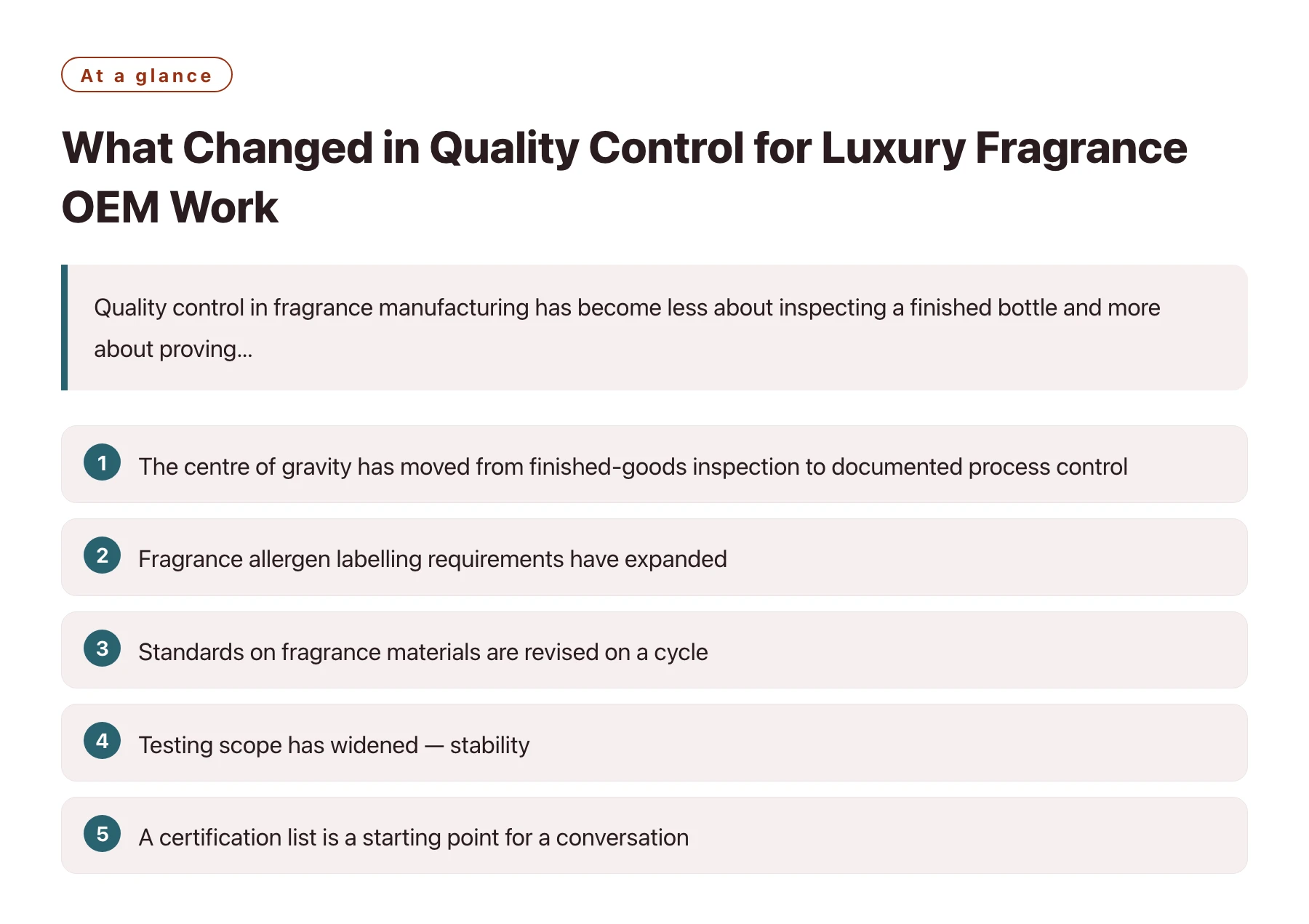
Key takeaways
- The centre of gravity has moved from finished-goods inspection to documented process control, where traceability is the evidence.
- Fragrance allergen labelling requirements have expanded, which means the formula and the label now have to be decided together.
- Standards on fragrance materials are revised on a cycle, so reformulation is a normal part of production rather than a sign of a problem.
- Testing scope has widened — stability, pack compatibility and microbiological quality are quoted as separate workstreams.
- A certification list is a starting point for a conversation; the batch record is what actually shows how a specific run was controlled.
Ten years ago, a brand buying fragrance production abroad often judged quality by the sample and the price. The assumption was that if the approved sample matched what arrived, quality had been delivered.
That assumption no longer survives contact with a compliance questionnaire. Retailers ask for documentation, importers ask for the product information file, and a formula that was compliant when a product launched may need review later because the material limits have moved.
This is an account of what has changed, written from the quality side of the relationship rather than the sales side, and of what a buyer should therefore ask for now that they would not have needed to ask for a decade ago.
From inspection to documented process control
The largest change is conceptual. Quality systems used to be organised around checking output: fill weight, appearance, spray function, aroma against a reference. Those checks still happen, but they now sit inside a documented process that begins with incoming materials and ends with a released batch, and the document trail is the part that buyers and regulators examine.
A cosmetics good manufacturing practice framework exists precisely to make that trail routine rather than heroic — material identification, batch numbering, weighing records, cleaning records, deviations and their disposition. Once a factory works that way, the question from a brand becomes simpler: show me the record for this run.
The practical test of whether a supplier has actually made this shift is not the certificate on the wall. It is whether they can walk a visitor through one batch record from intake to release without preparation.
Why luxury work feels the change first
High-end fragrance tends to involve more decoration, more component variety and more packaging, and every one of those adds a control point. A coated bottle, a metallised cap, an engraved plate and a rigid box with a printed insert are four separate supplier streams that have to arrive, be inspected, be reconciled against the batch and be recorded. The more components, the more a weak documentation habit shows.
It also involves smaller, more frequent runs at higher value, which raises the cost of a rejected batch. Documentation is what lets a factory identify whether a problem is a material, a process or a packaging interaction, instead of repeating the whole run to find out. A manufacturer that sets out their OEM/ODM manufacturing services in that much component detail is usually one whose control points are already written down, because customers have asked for them before.
Regulation has moved the formula and the label closer together
Fragrance is the most heavily regulated part of most cosmetic formulas, and two developments have pushed quality control earlier into the project.
The first is allergen labelling. The EU has expanded the list of fragrance substances that must be declared on a cosmetic label, with transitional periods for products already on the market [1]. The effect is that the composition of a fragrance now has a direct consequence for the artwork. A formula adjusted late in a project can invalidate a label that was already approved, which is why the sensible sequence is to settle the fragrance direction, then the declaration list, then the print file.
The second is the renewal cycle for fragrance material standards. The limits that apply to a material depend on the product category and the concentration, and they are revised periodically, which means a formula that was acceptable at launch may need review as the standards move [2]. This is normal industry practice rather than a defect, and a manufacturer who explains it calmly is usually one who has been through it before.
Behind those limits sits scientific assessment. The EU's Scientific Committee on Consumer Safety publishes opinions on fragrance materials and allergens that feed into the restrictions a formula has to respect, and those opinions are a reminder that the analysis is ongoing rather than settled [3].
What this means for a brief
A brief written today should say which markets the product is going to, because the declaration list and the material limits depend on it. It should also state whether the fragrance is expected to stay unchanged for several years, since a long product life increases the chance that a revision will touch it. Neither question was routine on a brief a decade ago.
What changed, and the evidence to ask for now
| Change | Consequence for the project | Evidence worth requesting |
|---|---|---|
| Process control replaced output inspection | Quality is judged on how the batch was made | A batch record from material intake to release |
| Allergen labelling list expanded | Formula and artwork must be settled in sequence | The declaration list agreed before the print file is final |
| Material standards revised on a cycle | Reformulation is routine and should be planned for | A statement of how revisions are tracked and notified |
| Testing scope widened | Stability, compatibility and microbiology are separate quotes | Test reports for the specific pack, not a generic scope |
| Retailer and importer questionnaires hardened | Documentation has to be assembled, not improvised | A document pack prepared before the order, not after |
| Sensory approval is more formal | Reference samples are retained and dated | The retained standard, sealed, with batch and date |
None of these items requires a new factory. They require a factory that already keeps the records, which is a different thing from one that can describe them.
Testing, sensory control and the limits of paperwork
Third-party laboratory work has become a larger line in project budgets. Stability under heat and light, compatibility between the concentrate and the pack, microbiological quality where the product is applied to skin, and any market-specific testing are normally quoted per test and per formula, and the published scope of a laboratory such as SGS shows how broad the menu has become [4]. Treating safety testing in perfume manufacturing as its own workstream, with its own schedule, is the habit that keeps a launch date intact.
Sensory control has moved in the opposite direction: it still depends on trained people, and it still resists being reduced to a specification. A retention programme with sealed reference samples, dated and stored under controlled conditions, is the practical answer. It is also the only way to settle the most common dispute in fragrance production, which is whether a delivered batch matches the approved sample or whether the sample itself has changed with time.
Trained evaluation is a skill rather than a form, and it is teachable. Formal perfumery training exists for exactly this reason — professional scent training is the kind of programme that produces the evaluators who sit between a formula and a release decision.
The honest limit of all this is that paperwork cannot make a mediocre product good. What it can do is make a good product repeatable, and make the cause of a failure findable. For a brand selling at a high price, the second half of that sentence is what protects the first.
One further change is worth naming: quality teams now expect the manufacturing partner to be able to explain its own scope. A factory that knows which steps it performs itself and which it buys in can describe where the control points are, and an audit can then follow the stated process instead of discovering it.
If a supplier's quality answer is a list of certificates, ask one more question: what happened on the last run that deviated from plan, and what was done about it. A factory with a working quality system will have an answer, because deviations are recorded. A factory without one will not, and that silence tells you more than the certificates do.
What a buyer should do differently
Ask for the quality system before the price. Ask for one redacted batch record. Ask how formula revisions are communicated and how long a reformulation takes. Ask which tests are included and which are quoted separately, and ask for the reference sample to be sealed and held by both sides.
Then compare the answers rather than the logos. Two suppliers may hold similar certifications and behave very differently when a batch goes wrong, and the difference is visible in advance to anyone who asks how deviations are handled.
A useful summary of the whole shift, written from the manufacturing side, is available in the discussion of quality control in luxury fragrance production — worth reading before a first audit visit, mainly because it makes the questions easier to ask in the right order.
Sources
- European Commission: Cosmetic Products — Specific Topics —— EU pages covering specific cosmetics topics such as product claims, nanomaterials and animal-testing rules.
- IFRA Standards Library (International Fragrance Association) —— The IFRA Standards Library lists the restrictions the fragrance industry applies to individual fragrance ingredients, based on safety assessments; it is the reference point for compliant fragrance formulation.
- EU Scientific Committee on Consumer Safety (SCCS) —— The EU scientific committee that issues opinions on the safety of cosmetic ingredients, including fragrance allergens and their labelling thresholds.
- SGS: Cosmetics, Personal Care & Household Testing —— Testing, inspection and certification services for cosmetics and personal care, including microbiological, stability and safety testing aligned with cosmetics GMP.
Frequently asked questions
Do I need to visit the factory to judge quality control?
A visit is useful but not decisive on its own. Ask for a batch record and a deviation log first; a site visit confirms what the documents suggest. Factories with strong systems are usually comfortable being asked to show both.
What is a retained reference sample for?
It settles disputes about whether a delivered batch matches what was approved, and it distinguishes a production change from the natural evolution of a stored sample. Keep a sealed, dated sample from the approved batch on both sides.
How often do fragrance material restrictions change?
The standards are reviewed on a cycle, so a product with a long life should expect at least one review. The practical protection is a supplier who tracks revisions and tells you when a formula needs attention, rather than one who waits to be asked.
Are certificates like ISO 22716 enough?
They indicate that a management system has been audited to a standard. They do not show what happened on a specific run. Use them as a filter for the shortlist, then ask for records.
Does harder regulation make luxury fragrance production slower?
It adds steps, particularly around labelling and documentation, but the delay usually comes from late decisions rather than from the rules themselves. Settling the formula, markets and label content in sequence removes most of the extra time.