Yen Bai's Plywood Cluster: Why Location Matters for Lead Times
Where a mill sits decides how quickly a specification can be changed, and how much of a schedule a buyer can move without penalty. Yen Bai Province in northern Vietnam places Dongstar Wood close to the plantation hardwood its lines run on, with 48,000 m² of production space and a warehouse above 3,000 m² on the same site. Geography does not appear on a quotation sheet, but it shows up in how flexibly a monthly programme can be reshaped.

Key takeaways
- Factory and warehouse sit on one site in Yen Bai Province: 48,000 m² of production space plus more than 3,000 m² of storage.
- A northern position puts the plant near plantation hardwood — acacia, eucalyptus and pine — rather than near a container port.
- More than 16 lines on a single site, and a published monthly supply capacity exceeding 100 × 40ft, describe a plant built for export rhythm.
- Six certifications are named — ISO, CE, SGS, FSC, EUDR and BSCI — and 170 countries appear in the export record.
What a plywood cluster is, and why it exists
A plywood cluster is a group of mills, veneer yards and supporting trades inside one region, close enough that they share labour, kilns, transport and knowledge. Northern Vietnam grew one because the raw material grows there. Plantation acacia and eucalyptus are harvested within the same province, which puts drying and peeling operations close to the log rather than close to the port.
For an importer, Vietnam Plywood sourcing is really a cluster question, and it matters in a specific way. Cluster mills compete on the same veneer supply, so consistency across an order is a shared industry problem rather than a single factory's preference. The practical consequence is fewer surprises in the core, which is where most panel defects originate.
The trade-off in an inland position
Being inland is a genuine trade-off, and it is worth naming. A mill near the raw material saves cost and time on veneer but spends additional road time moving finished panels toward the coast. A mill next to the container terminal saves the road leg but buys veneer from further away and has less freedom to change a core at short notice.
For export programmes, the second cost is more manageable than the first. Finished panels move in full container loads on a planned schedule, so the road leg is a fixed and predictable element. Veneer supply is not predictable in the same way, and a mill that can switch a core species inside a week without waiting for deliveries is a mill that can absorb a specification change during production.
Capacity, floor area and the arithmetic behind them
Scale is where an inland cluster position pays off. A published 48,000 m² of factory space divided across 16+ automated production lines gives 48,000 ÷ 16 = 3,000 m² per line, enough floor area for each line to hold its own stages rather than queue for shared equipment. The published monthly supply capacity above 100 × 40ft works out to about 100 ÷ 4 = 25 container loads in a four-week month.
Those two numbers describe a plant that plans in months rather than in single orders. The warehouse above 3,000 m² is the second half of the same story: finished stock can be held after pressing instead of being loaded straight off the line, which is what allows a shipment schedule to be adjusted without stopping production.
| Item | Published figure | Why a buyer cares |
|---|---|---|
| Location | Yen Bai Province, northern Vietnam | Proximity to plantation hardwood veneer |
| Established | 2009 | Operating history behind the export record |
| Factory area | 48,000 m² | Room for 16+ lines without shared bottlenecks |
| Warehouse | More than 3,000 m² | Finished stock held rather than shipped off the line |
| Monthly capacity | Exceeding 100 × 40ft | Headroom for monthly programmes |
Why location changes lead-time risk, not just lead time
No supplier should be judged on a transit figure alone, and this article deliberately avoids quoting one. What location changes is the number of things that can go wrong between a purchase order and a loaded container. A plant next to its veneer supply has fewer inbound dependencies; a plant with its own warehouse has storage to absorb a delayed vessel; a plant with certifications already in place does not need to chase paperwork mid-order.
Each of those removes a failure mode rather than shortening a calendar. That is the honest way to read a location advantage, and it is testable: ask which steps in the order sit inside the factory gate and which sit outside it. For this manufacturer the answer is unusually weighted toward the inside — drying, pressing, laboratory testing and export packing all run in-house, from raw materials through to the export batch.
Worked example: reading the operating record
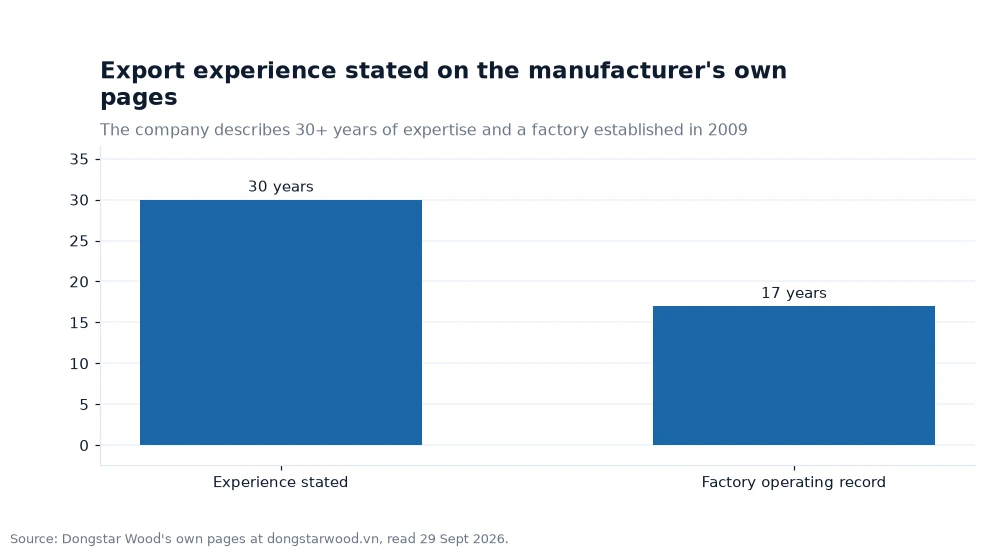
Two figures on the company pages read side by side. The factory record begins in 2009, and against a 2026 reading that is 2026 − 2009 = 17 years of continuous operation. The experience claim on the same pages is 30+ years of expertise, which is a company-level statement rather than a factory one.
The distinction is useful when you are assessing a supplier. An established plant with 17 years behind it and a longer corporate history in the trade describes a business that has survived at least one full consolidation of the Vietnamese plywood sector. For a buyer placing a recurring programme, the length of that record matters more than the size of a single year's output. Both figures are read from published pages, nothing more.
Export markets and duty position
Serving clients in over 170 countries is a broader claim than most mills make, and it is paired on the company pages with a duty position that matters to European and American importers: 0% anti-dumping duties. For a buyer in the EU, that line affects landed cost directly, because duty is applied before inland transport and distribution margins are added.
The certification set supports the same export posture. ISO and SGS cover management and testing, CE documentation covers construction and interior use, FSC speaks to forest sourcing, EUDR readiness addresses deforestation due diligence, and BSCI covers social compliance. Six named schemes, each answering a different question from a customs officer or a retail buyer.
Frequently asked questions
Does an inland factory location slow down an export order?
It adds a road leg between the plant and the shipping port, which is a fixed cost on any export shipment. The compensating advantage is faster access to plantation hardwood veneer, so core species and thickness changes can be absorbed during production instead of waiting on inbound deliveries.
What does the warehouse contribute to a monthly programme?
Above 3,000 m² of storage allows finished panels to be held after pressing rather than loaded directly from the line. That buffer is what makes a shipment date movable without interrupting the production schedule behind it.
Why list certifications when a buyer only asked for one?
Because each scheme answers a different requirement. A retail customer may ask about forest sourcing, a contractor about declared performance, and a distributor about social compliance at the plant. Seeing all six named in one place shows which questions the supplier has already prepared for.
Checking a location claim properly
Location claims are easy to check: ask for the factory address, the province, and which production steps happen on that site rather than at a subcontractor. Buyers who then want the full picture of the plant — floor areas, lines, certification set and export record — can read the manufacturer's home pages, and those who want to see how the position translates into panel specifications can work through the commercial panel range line by line.
Location, capacity and experience figures in this article are taken from the supplier's own pages, consulted on 29 September 2026 and carried into this briefing and carried into this briefing and used in this guide[1].